 EN



How Can High-Quality Custom Bruxism Mouth Guard Prevent Sleep Bruxism Damage?
Waking with a tight jaw, a dull headache, or teeth that feel unusually sensitive can be unsettling. A custom bruxism mouth guard is designed to create a protective barrier between upper and lower teeth while you sleep. It does not diagnose or cure bruxism, but a well-made guard can help limit the mechanical wear that repeated clenching and grinding place on enamel, restorations, and the biting surfaces of teeth.
As an oral-health product selection adviser, I suggest starting with the practical question: what must the guard protect, and what must it feel like for the wearer to keep using it? The answer is usually more useful than a broad claim that one style suits everyone. A high-quality custom bruxism mouth guard should be evaluated for fit, retention, material choice, finish, cleaning routine, and the right clinical boundary.
Why sleep bruxism can cause cumulative damage
Sleep bruxism involves clenching or grinding during sleep. A person may not notice it directly; a partner may hear grinding, or a dentist may see flattened edges, wear patterns, cracks, or stressed dental work. Mayo Clinic notes that persistent bruxism can be associated with worn enamel, tooth sensitivity, jaw or facial soreness, headaches, and damage to fillings, crowns, or other restorations. Those signs do not identify the cause on their own, but they are good reasons to arrange a dental assessment.
The damage is largely mechanical. When opposing teeth repeatedly contact under force, enamel and restorations carry that load directly. A custom bruxism mouth guard places a fitted layer between those surfaces. The National Institute of Dental and Craniofacial Research explains the basic purpose plainly: an intraoral guard separates the teeth to help prevent tooth damage and may reduce muscle activity related to grinding or clenching.
That distinction matters. A guard can protect teeth from contact forces; it is not a substitute for investigating pain, changing bite patterns, loud snoring, pauses in breathing, or other sleep concerns. If those symptoms are present, a dentist or an appropriate sleep-health professional can advise on the next step.
What makes a custom bruxism mouth guard more protective?
“Custom” should mean more than a label. A useful custom bruxism mouth guard is shaped from a reliable impression or scan so its edges, biting surface, and retention correspond to the wearer’s dentition. This helps distribute contact across the intended surface and reduces the urge to bite down just to keep a loose appliance in place.
1. Stable retention
A guard that lifts, rocks, or falls out is difficult to use consistently. Stable retention keeps the guard positioned over the teeth it is intended to cover and makes it easier to speak briefly, breathe normally, and settle into sleep. Fit should feel secure rather than painfully tight. A new guard that creates sharp pressure, sore gums, or a sudden uncomfortable bite needs review instead of prolonged “break-in” guessing.
2. A considered material and thickness
Material selection depends on the user’s grinding pattern, dental history, comfort preference, and professional recommendation. Softer materials can feel accommodating, while firmer designs may be selected for different force-management needs. There is no responsible universal thickness or hardness claim. The better question is whether the design, material specification, and finishing method are suitable for the intended wearer and verified by the clinician or supplier’s documented process.
3. Smooth, comfortable edges
Comfortable fit is not merely a sales phrase. A smooth finish helps reduce irritation to cheeks, tongue, and gums, making nightly use more realistic. At the same time, comfort should not be confused with a medical performance guarantee. A guard can feel comfortable and still require adjustment if it changes the bite, rubs tissue, or no longer sits securely.
How the guard limits damage night after night
Think of a custom bruxism mouth guard as a sacrificial interface: instead of tooth enamel or a restoration taking direct contact from every clench, the appliance receives the contact first. The guard can show wear over time, which is one reason regular inspection matters. Visible wear does not automatically mean failure; it can be useful evidence that the guard has been receiving force. Deep grooves, cracks, distortion, loose fit, or a rough edge are signals to have the appliance reviewed or replaced.
A quality guard also supports repeatable positioning. With a poorly fitting over-the-counter device, a wearer may shift it around, bite harder to keep it seated, or stop wearing it entirely. A custom fit cannot promise that clenching will stop, but it can remove common usability obstacles that undermine a protective plan.
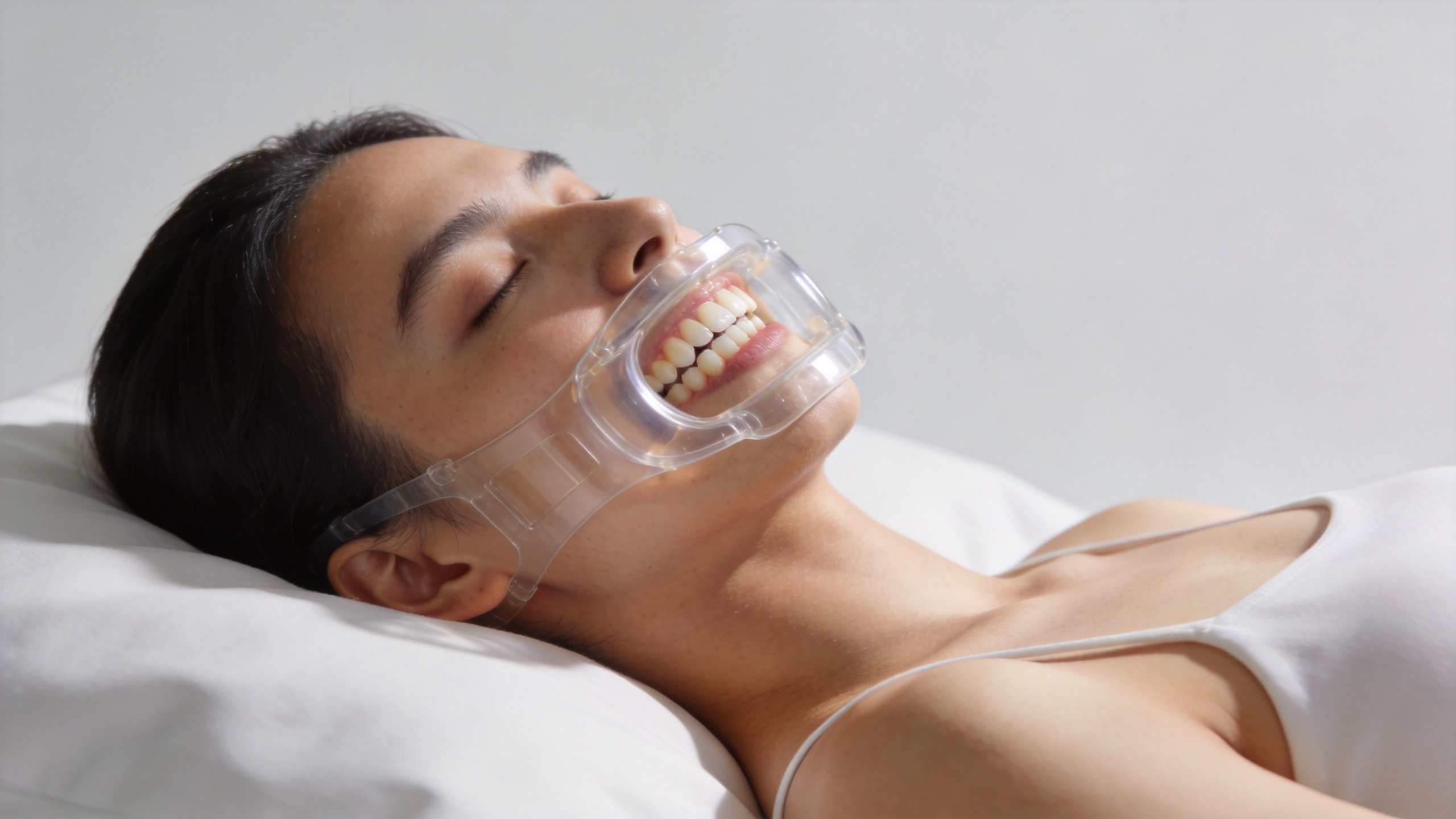
A practical fit-and-care checklist
- Confirm the intended use: Tell the dental professional whether the concern is nighttime grinding, daytime clenching, a damaged restoration, jaw discomfort, or a new sleep symptom. These are related but not identical situations.
- Check retention: The guard should seat fully and remain stable without repeated repositioning. Do not force it onto teeth if fit has changed.
- Inspect the contact surface: Look for marked grooves, cracks, cloudiness, distortion, or rough areas. Bring the appliance to dental visits when possible.
- Clean gently: Rinse after use, clean with a method recommended for its material, allow it to dry, and store it in a ventilated case. High heat can distort many thermoplastic materials.
- Keep the clinical boundary: Persistent pain, broken teeth, worsening headaches, breathing pauses, or a suddenly changed bite deserve professional evaluation rather than a product-only solution.
Questions buyers should ask about OEM/ODM supply
For clinics, distributors, pharmacies, or e-commerce teams, OEM/ODM sourcing should be approached as a documentation and consistency exercise, not just a price comparison. A custom bruxism mouth guard program may need different packaging, instructions, impression workflows, and fit-support language depending on the sales channel.
Ask prospective suppliers to clarify which material options are available, how impressions or scans are handled, how trimming and polishing are controlled, what cleaning and storage instructions are supplied, and how product specifications are versioned. If a product will be presented as dental or health-related, claims, labeling, and market-specific requirements should be verified before publication or sale. It is sensible to request samples for fit and finish review, but a sample is not proof of universal suitability.
For end users, the same principle becomes simpler: choose a product pathway that includes clear instructions, a means to report fit concerns, and a clinician when symptoms or dental conditions call for one. The goal is not the most dramatic claim; it is a repeatable, well-fitted protective routine.
When a mouth guard should be part of a wider plan
A custom bruxism mouth guard is most useful when it is matched to the person and reviewed over time. It may be only one part of a broader plan that addresses stress, sleep quality, medication questions, bite concerns, or sleep-disordered breathing. Mayo Clinic notes that people with sleep bruxism may also have sleep issues such as snoring or breathing pauses. That is a reason to seek evaluation, not a reason to assume a guard will solve every symptom.
In short, high-quality custom construction can help prevent sleep bruxism damage by separating the teeth, staying secure, offering a smooth and manageable wearing experience, and making wear easier to monitor. Pair those benefits with professional guidance when warning signs appear, and the appliance becomes a practical protective tool rather than an overpromised cure.
Frequently asked questions
Can a custom bruxism mouth guard stop teeth grinding?
A custom bruxism mouth guard is primarily intended to protect teeth from the effects of contact and grinding. It may support a care plan, but it does not by itself diagnose or guarantee elimination of the underlying behavior.
How do I know whether my guard still fits?
It should seat fully, stay stable, and feel free of sharp pressure. If it becomes loose, warped, cracked, painful, or associated with a changed bite, stop guessing and ask a dental professional to inspect it.
Is a comfortable fit enough to show that a guard is safe for me?
No. Comfortable fit is important for adherence, but it does not replace a dental review of symptoms, dental work, jaw pain, or sleep concerns. Comfort and clinical suitability should be assessed together.


 Hot News
