 EN



Why Is A Custom-Fit Sleep Bruxism Mouth Guard Crucial For Nighttime Protection?
When you wake with a tight jaw, a dull headache, or teeth that feel unusually sensitive, it is tempting to look for a quick, one-size solution. A sleep bruxism mouth guard can be an important protective layer, but its value depends on whether it stays in place, feels tolerable for hours, and creates a consistent barrier between the teeth. That is why fit deserves as much attention as material or price.
Bruxism means grinding, clenching, or gnashing the teeth, and it can occur during sleep. The National Institute of Dental and Craniofacial Research explains that an intraoral guard separates the teeth to help prevent tooth damage; it may also reduce muscle activity related to clenching or grinding. A guard is not a diagnosis or a cure for every cause of bruxism. It is a practical way to protect tooth surfaces while a dentist helps assess the broader picture.
Nighttime protection starts with a stable barrier
The central job of a sleep bruxism mouth guard is simple: it creates a buffer so upper and lower teeth do not directly rub or press against each other during episodes of nighttime grinding. That buffer can limit wear on enamel and dental work. Yet an appliance can only do that job reliably when it remains seated over the teeth throughout the night.
A loose guard may shift when the jaw moves. A bulky guard may make a sleeper remove it after an hour. A poorly shaped edge may irritate soft tissue. These are not minor comfort complaints; they can determine whether the guard is worn consistently enough to provide protection. In overnight use, small fit differences become more noticeable because the appliance must work while the wearer is asleep and cannot repeatedly readjust it.
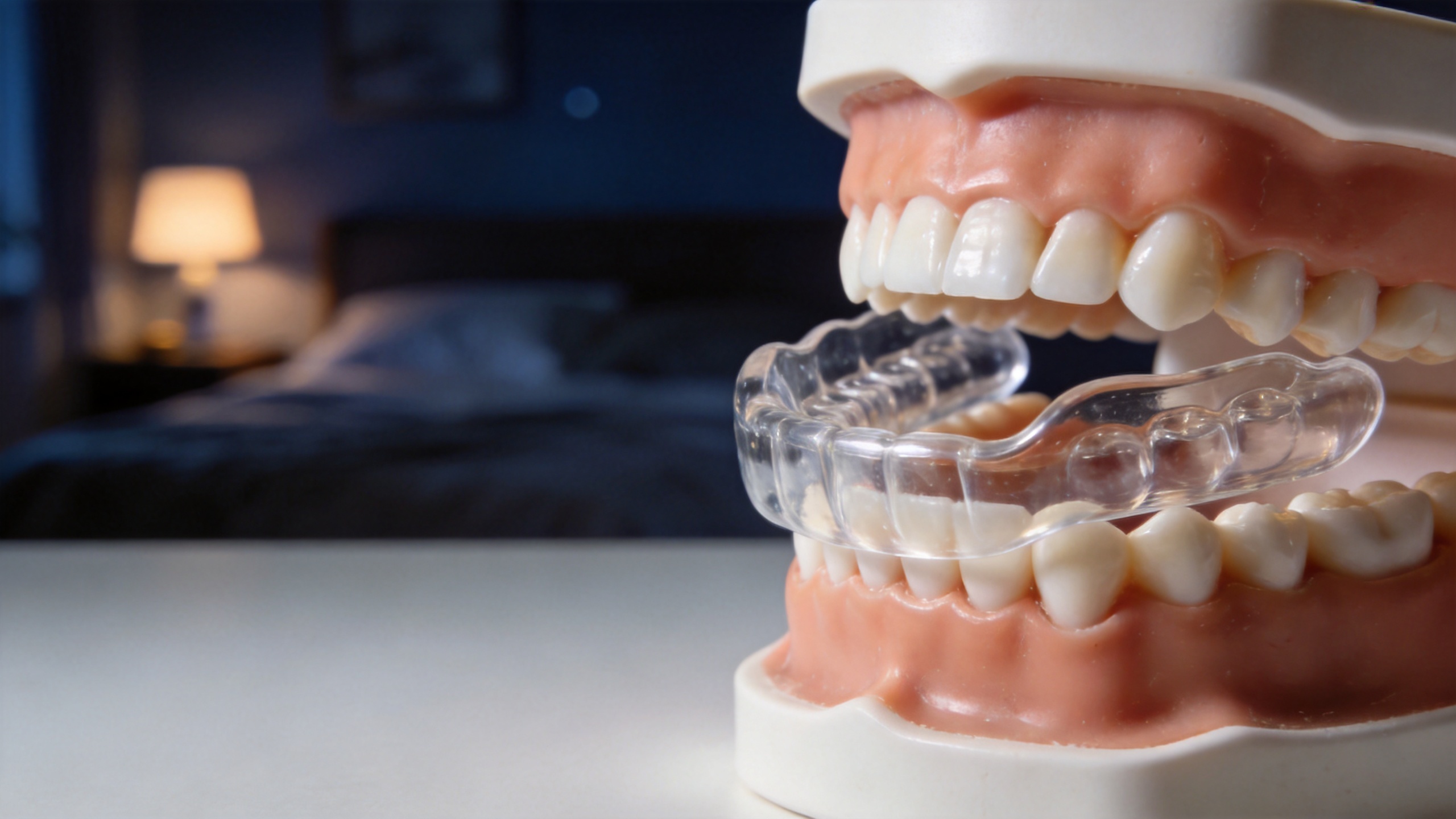
For this reason, a dental night guard should be evaluated as an overnight appliance rather than as generic cushioning. The American Dental Association’s MouthHealthy resource notes that a custom guard made from a special mold provides the closest, most comfortable fit. It also distinguishes a sleep guard from a sports mouth guard, whose extra cushioning may not be comfortable for sleeping.
Why custom fit changes the protection equation
1. It improves retention during sleep
A custom-fit sleep bruxism mouth guard is shaped to the individual tooth arch. That individualized contact helps the guard resist ordinary movement from breathing, swallowing, and jaw motion. Retention does not mean the device should feel painfully tight. It means it should be secure enough to stay in its intended position without the wearer needing to bite down constantly to hold it there.
2. It supports a more wearable profile
Comfort is not a luxury feature in this context. A guard that feels intrusive can interrupt sleep or end up on a bedside table. Custom shaping can help distribute contact more evenly across the arch and reduce unnecessary bulk around the gums and tongue. Individual needs vary, of course. People with sensitive gums, dental restorations, orthodontic appliances, or changes in their bite should ask a dental professional what design is appropriate rather than relying on a universal recommendation.
3. It helps protect the right teeth consistently
Grinding and clenching forces may be unevenly distributed. A properly assessed custom night guard is intended to provide coverage and contact appropriate to the wearer’s dentition, instead of leaving unpredictable gaps or concentrating pressure on a few spots. This does not ensure that jaw symptoms will disappear, but it gives the protective barrier a better chance to function as intended night after night.
4. It makes follow-up adjustment possible
Teeth, restorations, and symptoms can change. One advantage of discussing a sleep bruxism mouth guard with a dentist is that fit, wear patterns, and bite-related concerns can be reviewed over time. If a guard no longer seats properly, feels sharp, or shows notable wear, it is better to have it checked than to force continued use. A custom appliance is part of an ongoing protection plan, not a permanent substitute for reassessment.
Custom fit versus generic options: the practical difference
| Question | Custom-fit approach | Generic or loosely fitted approach |
|---|---|---|
| How does it stay in place? | Designed around an individual tooth arch. | May depend on a limited size range or self-adjustment. |
| What affects overnight comfort? | Contours and coverage can be assessed for the individual wearer. | Bulk, edges, and retention may be less predictable. |
| Can a professional review it? | Fit and wear can be checked in a dental setting. | Follow-up may be limited or absent. |
| What should it promise? | Protection from tooth-to-tooth contact, not a promise of cure. | The same boundary applies; broad health claims should be avoided. |
The point is not that every store-bought product is automatically useless or that every person needs the same appliance. The better question is whether the guard can provide stable, comfortable, appropriate protection for that person’s nighttime pattern. A custom mouth night guard is often worth considering when retention, comfort, tooth wear, or existing dental work make that question more important.
What a mouth guard can and cannot do
A sleep bruxism mouth guard can separate the teeth and help reduce damage from direct grinding contact. It does not automatically identify why the grinding occurs. Stress, sleep disruption, medication effects, bite concerns, and other factors may deserve attention. If someone snores loudly, has pauses in breathing, wakes gasping, or remains very sleepy during the day, those symptoms need professional evaluation rather than an assumption that a guard alone addresses the issue.
This boundary matters because consumer language can blur protection and treatment. It is reasonable to say that a guard may protect teeth. It is not responsible to promise that it cures bruxism, resolves temporomandibular joint disorders, or treats sleep apnea. When symptoms are persistent or worsening, a dentist can assess tooth wear, jaw tenderness, restorations, and whether referral or further evaluation makes sense.
Signs that merit a dental conversation
- New chips, flattening, sensitivity, or visible wear on teeth.
- Morning jaw soreness, facial muscle fatigue, or frequent tension headaches.
- A guard that cracks, no longer fits, or causes rubbing or pain.
- Changes in the bite, recent dental work, or an existing appliance that no longer seats fully.
- Sleep symptoms such as witnessed breathing pauses, choking, or marked daytime sleepiness.
These signals do not establish a diagnosis by themselves. They are useful reasons to move from guessing to a focused discussion with a dental professional.
A sensible checklist before choosing a guard
- Clarify the goal. Is the need tooth protection from suspected grinding, help with an existing appliance, or evaluation of jaw symptoms?
- Check fit expectations. Ask how retention, coverage, thickness, and edge comfort will be assessed for nighttime wear.
- Separate product information from health claims. A guard can be protective without being presented as a cure.
- Plan for review. Ask what to do if the guard becomes loose, uncomfortable, worn, or damaged.
- Consider sleep symptoms separately. If sleep quality or breathing is a concern, seek the appropriate professional evaluation.
The bottom line
A custom-fit sleep bruxism mouth guard is crucial for nighttime protection because protection depends on consistent wear, stable positioning, and tolerable comfort over many hours. The closest fit can help a guard stay where it belongs and maintain a barrier between the teeth while you sleep. It should be viewed as one part of thoughtful oral care: useful for protecting against grinding-related contact, but not a replacement for professional assessment when pain, tooth damage, bite changes, or sleep concerns are present.



 Hot News
