 EN



How Can Custom Night Guard For Braces Offer Better Comfort And Protection?
Wearing braces does not automatically make nighttime grinding concerns disappear. In fact, brackets, wires, changing tooth positions, and a changing bite can make appliance decisions more nuanced. A night guard for braces may sound like a simple purchase, but the right choice begins with your orthodontist’s guidance. A guard that was made before treatment, or a generic tray that presses unpredictably around brackets, may no longer match your mouth or treatment plan.
From an oral-health product selection perspective, the useful question is not simply “Which guard feels soft?” It is “What is this appliance meant to do, and can it work alongside active orthodontic treatment?” A custom night guard for braces is designed around a specific mouth at a specific point in treatment. That individual fit is why it can offer a more controlled experience than an unsupervised one-size-fits-all option—provided the treating orthodontist approves it.
Why braces change the night-guard decision
Braces create surfaces and movement that ordinary trays are not designed to accommodate. Teeth can shift during treatment, wires can be adjusted, and the way upper and lower teeth meet can change. For that reason, a night guard for braces should not be treated like a permanent appliance that can be ordered once and forgotten. Fit, coverage, and comfort deserve review whenever treatment changes.
Search guidance on orthodontic mouthguards commonly emphasizes that a guard can protect teeth and orthodontic hardware, while other results highlight an important qualification: not every grinding guard is appropriate during active treatment. Those viewpoints are not necessarily contradictory. They point to the same practical rule—your orthodontic team should decide whether a night guard for braces is suitable for your current stage of care.
How a custom fit can improve comfort
It follows the current shape of your teeth and hardware
A professionally planned night guard for braces can be made to account for brackets and other orthodontic features instead of forcing a standard tray over them. A controlled fit can reduce unnecessary pressure points, bulky areas, or edges that rub the lips and cheeks. Comfort does not mean the appliance should feel loose; it means it should sit as intended without obvious pinching, rocking, or interference.
It supports a more specific coverage decision
Custom design lets the clinician determine which teeth need coverage and how the appliance should relate to the bite. That is different from choosing a preformed tray based only on “small,” “medium,” or “large.” With a night guard for braces, the appropriate coverage and thickness depend on your orthodontic plan, grinding pattern, and the orthodontist’s assessment—not on a universal template.
It can be checked as treatment progresses
Because braces move teeth, a custom appliance may need monitoring, adjustment, or replacement. This is a practical benefit rather than a promise of a fixed lifespan. If a night guard for braces suddenly feels tight, no longer seats fully, changes how your teeth meet, or catches on a wire, stop using it and ask the treating practice for instructions. Do not try to reshape it at home.
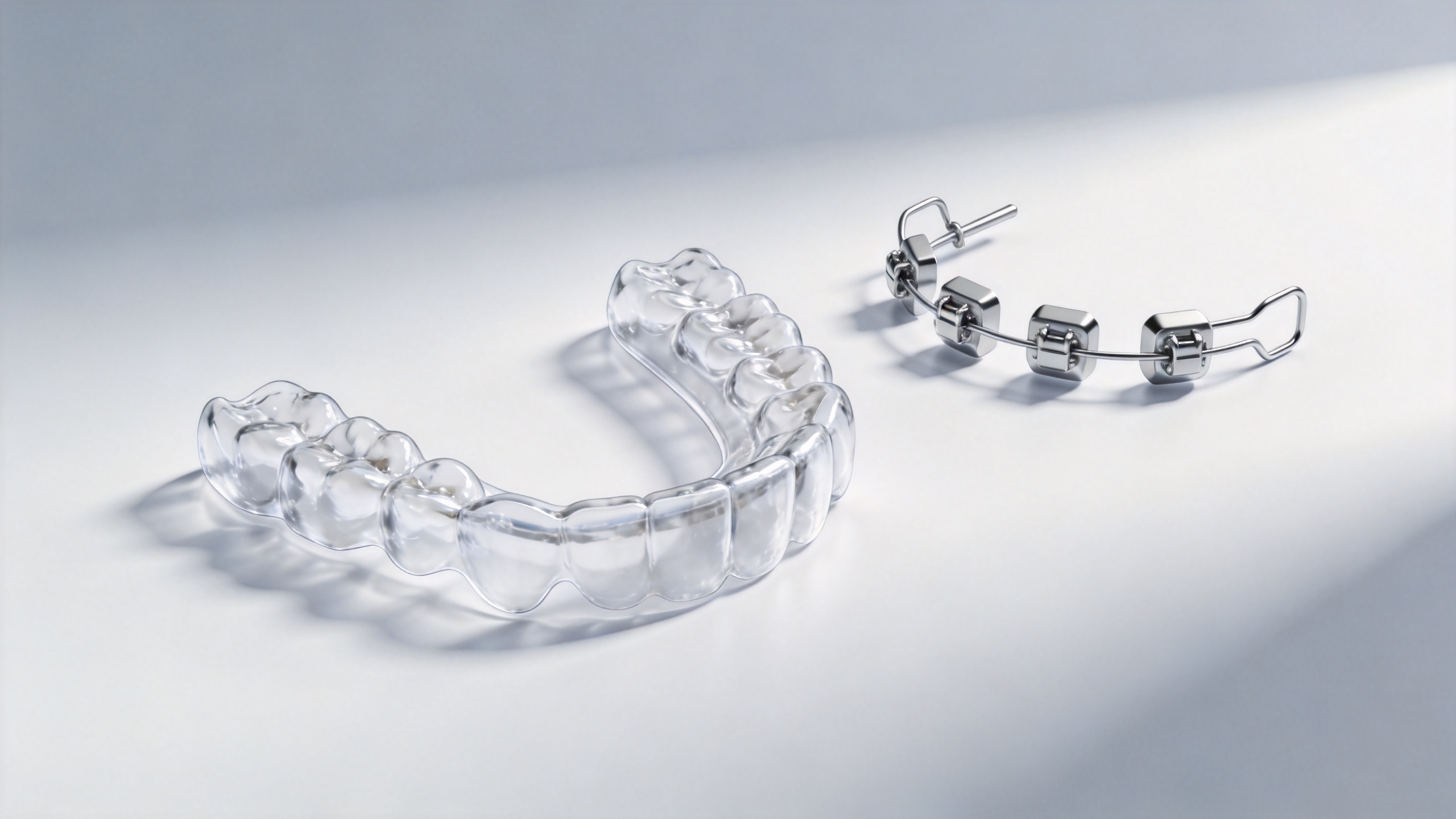
What kind of protection can it provide?
A night guard for braces is generally considered when a clinician wants to manage contact associated with nighttime clenching or grinding while accounting for orthodontic hardware. It is not a substitute for diagnosis or a guarantee that jaw discomfort, tooth wear, or sleep problems will resolve. Its protective role, if prescribed, is specific: creating an appropriate barrier or contact surface under professional direction.
That distinction matters. A night guard for braces is not the same as a sports guard, a retainer, or a clear aligner. A sports guard is intended for impact protection; a retainer is intended to help hold teeth after movement; and an aligner is intended to guide tooth movement. Although each may look like a tray, they should not be swapped or repurposed. A braces mouthpiece for athletic activity may require a different design from an appliance intended for overnight grinding.
Custom night guard versus a generic tray
| Consideration | Custom night guard for braces | Generic tray |
|---|---|---|
| Fit around orthodontic hardware | Planned from your current oral situation and clinical instructions | May not account for brackets, wires, or active tooth movement |
| Comfort review | Can be checked by the orthodontic team | Relies mainly on self-assessment |
| Bite relationship | Considered in the clinical plan | May create an unintended or poorly understood contact pattern |
| Changes during treatment | Can be reviewed when teeth or appliances change | May become unsuitable without clear warning |
The table is a decision framework, not a claim that every custom appliance is needed or suitable. The appropriate option is the one your orthodontist confirms is compatible with your treatment. A custom night guard may be more comfortable because it is built around current conditions, but custom manufacture alone does not make it appropriate without that confirmation.
Questions to ask before using a night guard for braces
- Is nighttime grinding or clenching the concern we are trying to address?
- Is a night guard for braces appropriate at my current treatment stage?
- Should it cover the upper teeth, lower teeth, or neither at this time?
- How should it fit around my brackets, wires, attachments, or elastics?
- What signs mean I should stop wearing it and contact the practice?
- When should the fit be reassessed as my teeth move?
These questions shift the conversation from a product name to a use goal. That is particularly important for a dental night guard during braces treatment: the goal is compatibility with care, not simply a thicker or softer material.
Safe-use habits that protect comfort
If your clinician approves a night guard for braces, follow the wearing, cleaning, and storage directions they provide. Bring the guard to orthodontic appointments when asked so the team can evaluate fit. Keep it away from heat unless your clinician specifically instructs otherwise, since heat can distort some materials. Do not use a damaged, cracked, loose, or sharp-edged guard. Small changes in fit can matter more during active treatment than they would after orthodontic care is complete.
Also report new soreness, a bite that feels different after removal, gum irritation, a guard that no longer seats, or a loose bracket or wire. These signs do not establish a diagnosis, but they are good reasons to seek professional advice before continuing with a protective night guard.
The practical takeaway
A night guard for braces can offer better comfort and protection when it is selected for a clear purpose, shaped for the mouth as it is now, and monitored by the orthodontic professional directing treatment. The most important benefit is not the word “custom” by itself. It is the ability to evaluate fit, bite contact, orthodontic hardware, and changes over time together.
If you grind or clench at night while wearing braces, ask your orthodontist whether a night guard for braces is appropriate before trying any tray on your own. That conversation helps separate an appliance that may fit your treatment plan from one that could interfere with it.


 Hot News
